Our Story
From the Lenape trails to the Kinney estate to the neighbors who call it home today — this place has always been something worth protecting.
Before
The Land Where the Smoke Rises
The land you live on was once Lenni-Lenape hunting ground.
For thousands of years before there were gates or guards or property lines, the Lenape, the Original People, lived on this land. They were part of the Algonquian nation, known to neighboring tribes as 'the Grandfathers' for their wisdom and nobility. They hunted deer and bear through these same mountain ridges. They fished the streams that still feed our lake. They gathered wild plants in the meadows and forests that surround us. They called their homeland Lenapehoking — 'the land where we dwell' — and they called this corner of it by a name that stayed: The Land Where the Smoke Rises, for the mist that lifts off the water at dawn and dusk. Today, their descendants, the Ramapough Lenape Nation, still live in the Ramapo Mountains just north of here, roughly 5,000 strong. The name Smoke Rise is not something a developer invented. It is a Lenape name. It is the oldest thing about this place.
1600s–1800s
Iron, Furnaces & the First Settlers
Before there were homes, there were forges.
The first European settlers came to this area in the late 1600s, drawn not by the beauty but by the iron. The Great Charlotteburg Furnace Tract (charcoal furnaces and iron mines along the Pequannock River) made this region one of the most productive ironworking centers in colonial New Jersey. During the Revolution, Robert Erskine, George Washington's personal surveyor, posted the first organized militia in New Jersey right here to protect the furnaces from British raids. When the furnaces cooled, Dutch and German farming families moved in — the Meads, the Deckers, the Rickers — names you can still find on Kinnelon roads today. The Meadtown School the town still keeps — the Kinnelon Museum on Kinnelon Road — is the 1873 schoolhouse that replaced Meadtown's first school of 1839.
1880s
A Tobacco Entrepreneur Finds His Mountain
He could have chosen anywhere. He chose here.
In 1890 the Kinney brothers' tobacco business folded into the American Tobacco Company; by local account Francis Sherwood Kinney came away with some $5 million in proceeds. He could have built his estate anywhere in America. He chose a swath of rocky, rising land in Morris County's northwest corner and began buying parcels (45 of them between 1885 and 1920) until he held over 5,000 acres of mountain wilderness. He built a stone manor with eight chimneys that he called 'The Cottage.' He called the estate 'Kinney Lawn.' The Village Inn you eat at today was his dairy barn. The Club office was his firehouse. The stone walls along Perimeter Road were built by his workers more than a century ago. To get here from Manhattan, Kinney would catch the 9:15 train to Butler — the New Jersey Midland Railroad had extended track through town in 1871 — and a horse-drawn coach would meet him at the Butler station at 5:14 for the ride up the mountain to the estate. His brother Abbot went the other direction entirely, to Southern California, where he founded Venice Beach.
1886–1889
Tiffany's Chapel
Louis Comfort Tiffany, before he was Tiffany.
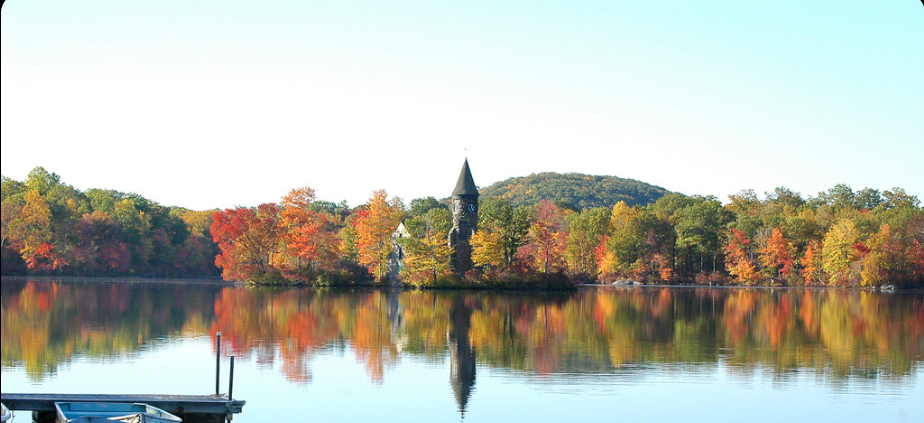
Francis Kinney built St. Hubert's Chapel between 1886 and 1889 on a small island in what is now Lake Kinnelon, so his wife Mary wouldn't have to travel to a distant Catholic church. He named it for the patron saint of hunters. Accessible only by boat, the chapel was designed and decorated by Louis Comfort Tiffany as one of his earliest ecclesiastical commissions. Its bold stained glass Celtic cross window and interior decorations were groundbreaking work — the kind of project that shaped everything Tiffany did in churches afterward. The windows in that chapel are among the finest surviving examples of his early stained glass anywhere in the country. Vandals damaged much of the interior beginning in the 1950s, but a comprehensive restoration (funded by individual, family, and foundation donations) has brought the windows, marble floors, altar, statues, and clocktower back to life. That chapel belongs to us.
1946 → Today
A Community Takes Shape
A way of life that most of America paved over.
In 1946, the Kinney estate became the Smoke Rise Club — a gated residential community built on an idea that still feels radical: that you could live 35 miles from Manhattan and still have mountain air, a private lake, and neighbors who know your name. Homes rose along winding roads through the 1950s, '60s, and '70s. Families arrived. The lake, the Inn, the chapel, the gates, the guards — a way of life took shape. When the borough incorporated in 1922, they named it Kinnelon after the family whose estate made it all possible. Eighty years later, more than 900 homes sit along winding roads behind 24-hour gates. The lake is still here. The Inn is still serving. The chapel is still standing. This is what we're talking about when we talk about 43 North Road. Not just a building. The question of what we preserve, what we build, and what we pass on.
Now
Something Worth Preserving
Eighty years of history. One building at the gate. A community ready to decide.
Most of this history lives in scrapbooks, in private memory, in the Kinnelon Museum down the road, and in the quiet dedication of neighbors who have spent years restoring the chapel and caring for the old stone buildings. That work matters. Now, with 43 North Road — the building at our North Gate — there's a chance to do something more. Whatever this property becomes, it should reflect the community it represents. That's why we're asking. Not because something is broken, but because something is worth building.