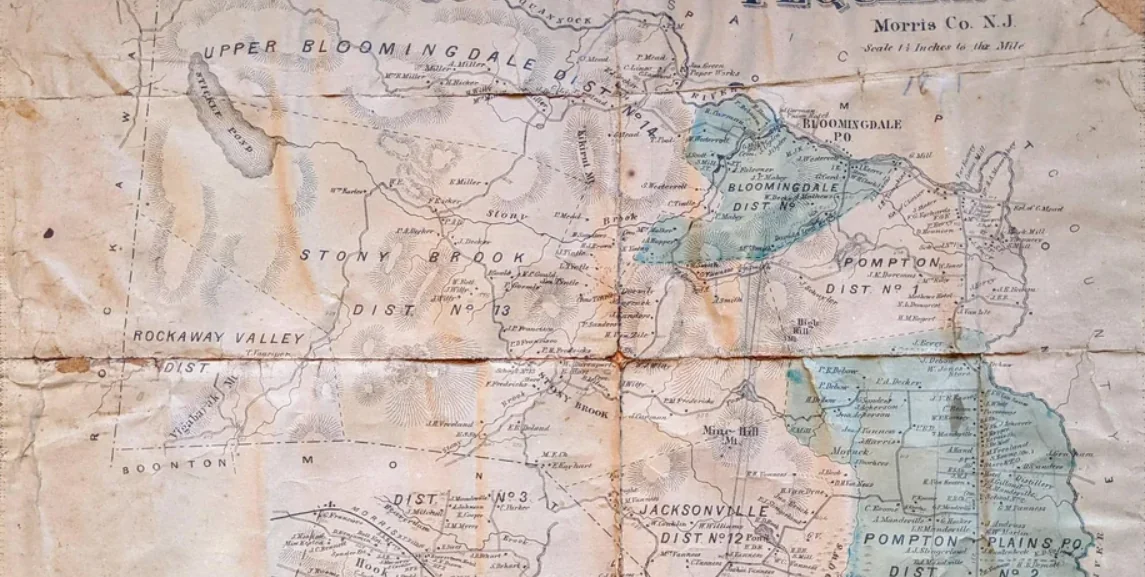
Long before there was a borough, there were the mountains — and the mist that rose off them at dawn, which the Lenape named in words later translated as “the land where the smoke rises.” The last glacier had already done its work, scattering house-sized boulders across what is now Pyramid Mountain.
European settlers followed Arent Schuyler into the Pompton valley in 1695, and farming families — the Meads, Stickles, Cobbs, and Fredericks — took to the hills. In the iron century the Charlotteburg furnace, named for Queen Charlotte, drew this corner of the highlands into the Revolution.
Then came a tobacco fortune. In the 1880s Francis S. Kinney bought up some five thousand acres and, with them, a name: his estate “Kinney-lawn” became Kinnelon when the borough incorporated in 1922. The lakes followed — Fayson Lakes rising from the old Fredericks farm, Smoke Rise from the Kinney estate, Lake Reality from a pond once called Tony's — each its own community, all of them Kinnelon. This is that story, century by century.
The story, century by century
Before the 1600s
Deep time & the Lenape

Photo: Steven Reynolds · CC BY 2.0
The last glacier scattered house-sized boulders across what is now Pyramid Mountain, and the Lenape named the dawn mist that rose off these hills — words later translated as “the land where the smoke rises.”
c. 18,000 yrs ago
The last glacier retreats
The ice sheet pulls back, leaving Pyramid Mountain's giant erratics — Tripod Rock and Bear Rock — strewn across the highlands.
Read the storyBefore the 1600s
Lenape homeland
The Lenape live across these ridges; the dawn mist gives the land an enduring name — where the smoke rises — and the word Pequannock survives to this day.
Read the story
1695–1870s
The first settlers & founding families
European settlers followed Arent Schuyler into the Pompton valley in 1695, and farming families — the Meads, Stickles, Cobbs, and Fredericks — took to the hills, their names later charted across the 1868 Beers atlas.
1695
The first European settlers
Settlers led by Arent Schuyler purchase land in the Pompton region, opening this corner of the highlands to European farming.
Read the story1700s
Land grants and the Fredericks farm
The Mead, Stickle, and Cobb families take up Proprietor land grants; the Fredericks build one of Morris County's oldest stone farms — later Fayson Lakes.
Read the story1740
Pequannock Township is formed
Kinnelon's parent township is established, spanning Kinnelon, Butler, Pompton Plains, Riverdale, and Montville.
Read the story1839
The first Meadtown School
A one-room schoolhouse is built below Wilton Mead's house in Meadtown; it serves the district until 1873.
Read the story1873
L'Ecole — the schoolhouse that became the museum
A new Meadtown schoolhouse replaces the 1839 one; this 1873 building later becomes L'Ecole and stands today as the Kinnelon Museum.
Read the story1868
The Beers Atlas maps the valley
F.W. Beers's atlas charts the Fredericks family and roughly thirty other households on its Pequannock plate — the founding families, by name.
Read the story
1765–1783
The iron century & the Revolution
The Charlotteburg furnace, named for Queen Charlotte, drew this corner of the highlands into the Revolution — its ironmaster Robert Erskine supplied the Continental Army and became George Washington's Surveyor-General.
1765
The Charlotteburg furnace
Peter Hasenclever raises the Great Charlotteburg iron furnace for the American Iron Company, naming the tract for Queen Charlotte.
Read the storyRevolution era
Iron for the war
Charlotteburg's ironmaster Robert Erskine supplies the Continental Army and becomes George Washington's Surveyor-General.
Read the story
1880s–1900
The Kinney estate

Photo: NABFNJ · CC BY-SA 4.0
The tobacco magnate Francis S. Kinney assembled a roughly 5,000-acre estate — “Kinney-lawn” — and built St. Hubert's Chapel on an island in the lake, Louis Comfort Tiffany's first liturgical commission.
1880s
Kinney builds “Kinney-lawn”
Tobacco magnate Francis S. Kinney assembles a ~5,000-acre estate on Stickle Pond — the seed of both Smoke Rise and the borough's name.
Read the story1886–1889
Tiffany's island chapel
Kinney builds St. Hubert's Chapel on an island in the lake — Louis Comfort Tiffany's first liturgical commission.
Read the story1900
Newark buys the watershed
The City of Newark purchases the ~35,000-acre Pequannock Watershed, locking much of the highlands — Kinnelon included — into permanent open space.
Read the story
1922
The borough of Kinnelon
Kinnelon incorporated on February 20, 1922, taking the Kinney estate's name — “Kinney-lawn” became Kinnelon — and Warren Kinney became its first mayor.
1925–1970s
The lake communities
The lakes followed — Fayson Lakes rising from the old Fredericks farm, Smoke Rise from the Kinney estate, Lake Reality from a pond once called Tony's — each its own community, all of them Kinnelon.
1925–1927
Fayson Lakes
Frank Fay develops the old Fredericks farm into a lakeside summer colony, filing the “Fayson Lakes” map in 1927.
Read the story1933
The Casino speakeasy
John Canty builds a stone dine-and-dance speakeasy on Lake Canty — later the centerpiece of Silas Condict County Park.
Read the story1937
The WPA builds the Kakeout Reservoir
The Works Progress Administration dams Stone House Brook on Miller Road's shoulder, creating the Kakeout (Butler) Reservoir — still the source of Butler's drinking water today.
Read the story1946
The Smoke Rise Club
The former Kinney estate becomes the Smoke Rise Club — “Created by Nature – Preserved by Man.”
Read the story1954
Our Lady of the Magnificat
A stone chapel rises on Miller Road, built by Henry Wise Miller for the poet Alice Duer Miller and dedicated in July 1954.
Read the story1961
Lake Reality
The former “Tony's Pond” is dug out and Lynnview Estates rises around it.
Read the story1962
A parish on Miller Road
Our Lady of the Magnificat is canonically erected as a parish under its first pastor, Fr. John R. Ryan; the parish cemetery opens in 1965.
Read the story1953–1964
Silas Condict County Park
Morris County acquires the old Canty estate and dedicates Silas Condict County Park — today some 1,500 acres adjoining the Smoke Rise lands.
Read the story1973
The parish church is dedicated
A building drive begun in 1970 culminates in the dedication of the Our Lady of the Magnificat church, whose school was run by the Sisters of St. Joseph of Chestnut Hill.
Read the story
1988 — today
The living town
The story is still being written — by neighbors like Lucy Meyer, whose grassroots campaign saved Pyramid Mountain, and by the women whose stories the town is only now setting down.
1988–1989
Pyramid Mountain is saved
Lucy Meyer's grassroots campaign halts development around Tripod Rock; Pyramid Mountain becomes a Natural Historic Area in 1989.
Read the storyToday
One borough, many communities
Smoke Rise, Fayson Lakes, Lake Reality and more — distinct communities, one Kinnelon, ringed by preserved watershed and parkland.
Explore the stories
Smoke Rise
The land where the smoke rises — a tobacco fortune, a Tiffany chapel, and a community that chose to stay wild.
Kinnelon
Charlotteburg, the ironlands, and a borough named for a tobacco baron's estate, incorporated in 1922.
Charlotteburg
Before the lakes and the gates, these hills made iron — the Great Charlotteburg Furnace Tract.
Fayson Lakes
The old Fredericks farm — one of Morris County's oldest homesteads — and the three lakes the Fays built on it.
Miller Road
A stone chapel, a New Deal reservoir, a suffrage poet's memory, and the longest dead-end in town — Miller Road is Kinnelon's history laid end to end.
Lake Reality
Once Tony's Pond — and the one Kinnelon lake open to the whole borough.
Silas Condict Park
A patriot's name, a Prohibition speakeasy by a lake, and a thousand acres held in common.
Pyramid Mountain
Glaciers, outlaws, and the grassroots fight that saved it.
Founding Families
Land-grant farmers, ironmasters, a tobacco magnate — and the surnames the 1868 atlas itself prints on the land.
The Women of Kinnelon
A chapel built for one woman's faith, a mountain saved by another's will, a town's history written by a woman told it had none — Kinnelon's story is, in large part, the story of its women.
Kinnelon history — frequently asked
Who was Kinnelon named for?
The Kinney family. Francis S. Kinney, a New York cigarette magnate, assembled a roughly 5,000-acre estate here in the 1880s; when the borough incorporated in 1922 it took the family's name, and his son Warren Kinney became its first mayor.
Source: Wikipedia — Kinnelon, New Jersey
When was Kinnelon founded?
In 1922, when the Kinnelon section split from Pequannock Township to incorporate as its own borough — a community of only about four hundred people at the time.
Source: Wikipedia — Kinnelon, New Jersey
What was the Kinnelon area before it was a borough?
Part of Pequannock Township, established in 1740. Before European settlement it was Lenape land; local accounts record that in 1695 acreage here was purchased from the Minisink sachems Onagepouck and Sajapogh.
Source: Wikipedia — Pequannock Township; local history
What is St. Hubert's Chapel?
A Louis Comfort Tiffany–designed stone chapel on an island in Lake Kinnelon, raised by Francis Kinney for his wife Mary. Its cornerstone was laid in 1886 and it was consecrated in 1889; it carries Tiffany's first liturgical commission.
Source: Diocese of Paterson, “A Catholic Legacy”; Wikipedia
What is Our Lady of the Magnificat?
The stone chapel at 2 Miller Road, built in 1954 by Henry Wise Miller as a tribute to his late first wife, the writer Alice Duer Miller. It grew over the following decades into a full parish — a school, a convent, a cemetery, and a church.
Source: olmchurch.org — Parish History; Steve Sears (My Paper Online)
Who was Alice Duer Miller?
A celebrated writer — poet, novelist, and screenwriter — whose 1915 suffrage satire Are Women People? and 1940 verse novel The White Cliffs made her nationally known. The chapel Our Lady of the Magnificat on Miller Road was built in her honor by her husband, Henry Wise Miller, in 1954.
Source: Wikipedia — Alice Duer Miller; Academy of American Poets
How did Meadtown get its name?
From the Mead family, among the area's earliest farm families. Meadtown's schoolhouse — a first school in 1839, replaced by a larger one in 1873 — became known as L'Ecole, and that 1873 building stands today as the Kinnelon Museum.
Source: Lucy Meyer, Kinnelon: A History; L'Ecole Kinnelon Museum
Who created Fayson Lakes?
The Fay family — the developer Frank Fay Jr. and his son Frank Fay III — who bought 240 acres in 1925 and laid out the summer lake community, its name reading as “Fay” plus “son.”
Source: Fayson Lakes Association