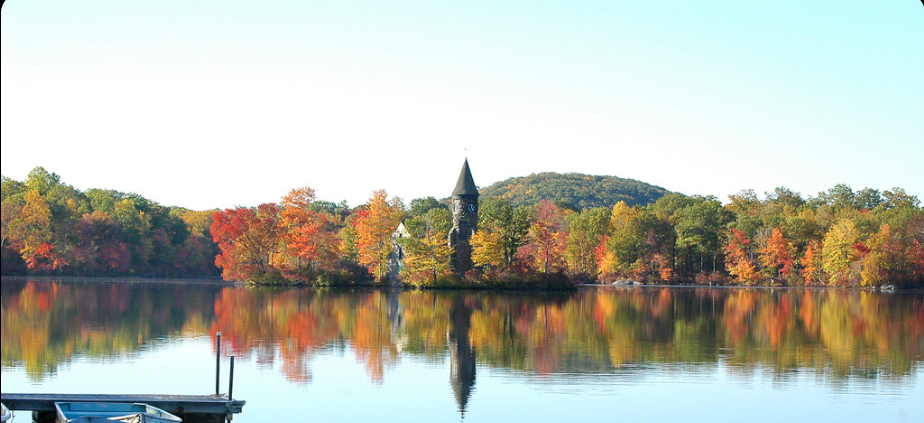
Before the lakes: a colonial frontier
The hills and lake basins of this corner of Kinnelon were shaped by the last glaciation and were long Lenape land — the name Pequannock is Lenape in origin. European settlement began in 1695, when settlers led by Arent Schuyler purchased land in the Pompton region, first from the Indians and then from the Board of Proprietors, claiming the meadows and streams below these hills. Through the 1600s and 1700s the Mead, Stickle, and Cobb families took up land grants from the Proprietors, and in 1740 Pequannock Township was formed — at the time spanning Kinnelon, Butler, Pompton Plains, Riverdale, and Montville.
The Fredericks farm
In the mid-1700s the Fredericks family built their homestead on land bought from the Cobb's patent — a one-and-a-half-story random-fieldstone farmhouse, its walls some twenty inches thick, set into the bank above a spring brook that still flows beneath it. It is one of the oldest houses in Morris County; a later wing added in the early 1800s carried Greek Revival mantels and period detailing. The Fredericks were working farmers: a 1795 family inventory records corn and vegetables raised for market alongside cows, sheep, and horses, and in 1785 Peter Fredericks even registered his livestock mark. Peter served as a Morris County Freeholder for Pequannock Township in 1793 and as an overseer of the poor. The family lived on this land for nearly two centuries.
The family graveyard
The Fredericks graveyard still lies within Fayson Lakes, its marked graves dating back to 1745 — with a number of unmarked stones that may be older still.
Mapped in 1868
The farm and its neighbors appear on the Pequannock plate of F.W. Beers's 1868 Atlas of Morris County, which shows the Fredericks family and roughly thirty other landowner families — a snapshot of the neighborhood more than half a century before Kinnelon became a borough in 1922.
The orchard years
In the early 1900s the farm passed to the Kitchell family, who worked it as an apple orchard. Around 1925 the Kitchells sold the old Frederick farm and its lake to developer Frank Fay Jr., who kept harvesting the apples and made apple jack from them; a venerable apple tree, said to be more than a century old, long stood on the property.
The Fays build Fayson Lakes
Frank Fay Jr. and his son Frank Fay III had ridden over the mountain by horseback from Pompton Plains and, taken with the hills, bought the farm with development in mind. They acquired about 240 acres around a small pond — later West Lake — and in 1927 filed the subdivision map for “Fayson Lakes.” The name is usually read as “Fay” plus “son,” for the father-and-son developers, though that tidy gloss is best treated as folk etymology. The first log cabin was offered to Charles Lindbergh as a promotion — whether it drew any response is undocumented — and the Fays advertised the new retreat heavily in The New York Times and New Jersey papers. By local accounts, roughly two dozen chestnut-and-stone weekend cabins went up within a few years.
How the lakes took shape
The community began around a single body of water, West Lake. In 1931 an adjoining property added East Lake, and the name became “Fayson Lakes,” plural. A further parcel acquired by 1938 was eventually dammed in the 1950s to form a third lake, South Lake. (These are the names tied to the community's development; some present-day sources use different lake names, which the Fayson Lakes Association's own records would settle.)
Trails, and a road for the mayor
The first roads were laid out as loops through the woods, and by local accounts they are still called “trails” to this day. Early residents kept their automobiles in garages down on Stonybrook Road; when Frank Fay Jr. was elected mayor of Kinnelon in 1931, that road was hard-surfaced and renamed Fayson Lakes Road — the name it carries still.
Fayson Lakes today
Today Fayson Lakes is a private lake association of more than 530 member families — Kinnelon's highest-density neighborhood — three lakes with sand beaches and lifeguards, and an active roster of clubs: Women's, Men's, Swim, Tennis, Recipe, and Yacht. The Association carries annual member dues and a dedicated annual dam assessment for the upkeep of its lake dams.
“For nearly two centuries this was the Fredericks farm. The lakes came later.”