The name
“Smoke Rise” is a translation of the old Lenape name for these mountains — for the mist that rose off the ridges at dawn. The land where the smoke rises. The Lenape word Pequannock survives in the township and the river.
The Land Where the Smoke Rises — a tobacco fortune, a Tiffany chapel, and a community that chose to stay wild.
“Smoke Rise” is a translation of the old Lenape name for these mountains — for the mist that rose off the ridges at dawn. The land where the smoke rises. The Lenape word Pequannock survives in the township and the river.
In the 1880s Francis S. Kinney — whose Kinney Brothers tobacco company made the wildly popular Sweet Caporal cigarette — began assembling a mountain estate of some five thousand acres here, with a summer cottage on the water then known as Stickle Pond (today's Lake Kinnelon). He called the estate “Kinney-lawn”; the name later contracted into Kinnelon.
Francis Sherwood Kinney (1839–1908) built one of America's first great cigarette fortunes. From around 1869 his Kinney Tobacco Company mass-produced cigarettes — the hugely popular Sweet Caporal arrived in 1878 — and Kinney Brothers helped pioneer the collectible card tucked into every pack, the 1880s sets of actresses, animals, flags, and naval vessels that collectors still chase. When James B. Duke consolidated the trade, the firm folded into the American Tobacco Company in 1890. His younger brother and partner, Abbot Kinney, took his own fortune west and founded Venice, California. When the borough incorporated in 1922 the town kept the contracted name Kinnelon, while the family's own estate took the name it still carries — Smoke Rise.
Kinney's Smoke Rise was less a country house than a self-contained estate village. Along what is now Perimeter Road he raised stables and carriage barns for a Brown Swiss dairy herd, a blacksmith shop, greenhouses, a piggery, an icehouse, and a firehouse — most of them built before the turn of the century from native stone quarried on the property. Stonehouse No. 4, which the family is said to have raised on an older foundation in 1885, is generally counted the oldest building still standing in Smoke Rise.
In 1904 Morris Kinney built a stone tower on the summit of Kitty Ann Mountain — at about 1,150 feet the high point of the estate — to keep watch over the family's five thousand acres. Some eighty feet tall and fifteen feet square at its base, quarried from stone on the mountain and crowned with castle-like battlements, on a clear day it looks out to the Manhattan skyline thirty miles to the southeast. In the Second World War it served as an aircraft observation post and, later, as a state forest-fire lookout; its original iron stairs rusted away after the war. In 1964 the Smoke Rise Club restored the tower — new iron stairs and all — as a memorial to the community's founder, John Alden Talbot Sr., who had died on Christmas Day 1962; the work was led by his son, John Alden Talbot Jr.
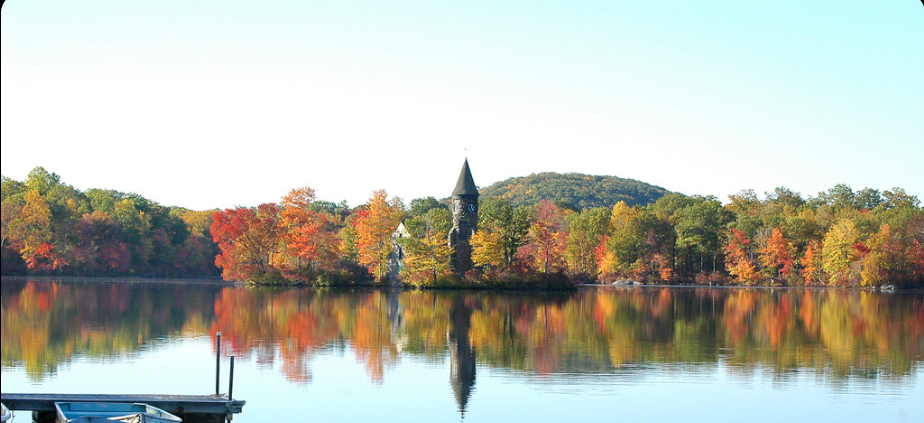
Between 1886 and 1889 Kinney built a small stone chapel on an island in the lake for his devout Catholic wife, Mary, so she wouldn't have to travel the seven miles to the nearest church in Butler — though Kinney himself was not Catholic. He named it for St. Hubert, patron saint of the hunt, and modeled it on an 8th-century stone chapel. Completed in 1889, it was the first consecrated Roman Catholic place of worship in Kinnelon — and it carries Louis Comfort Tiffany's very first liturgical commission: the altar, stained glass, tile floor, chandelier, and a front door inscribed “Sancte Huberte, Ora Pro Nobis.” It still stands on Chapel Island, reachable only by boat.
The chapel served the family into the early 1950s, then fell quiet and suffered vandalism. Beginning in the 1980s, volunteers of the Kinnelon Heritage Conservation Society undertook a painstaking restoration; the tower clock is still hand-wound, and the chapel opens to the public a few days each year.
After Morris Kinney died in 1945, he left the estate to his friend John Alden Talbot Sr. — a New York real estate developer, a founder of Chilton Hospital, a patron of the arts credited with helping revive American ballet in the 1930s, a former mayor of Kinnelon, and, by lineage, a direct descendant of John Alden of Plymouth Colony. Rather than carve the land into an ordinary subdivision, Talbot chose to build a planned residential club. In November 1946 the Smoke Rise Club was formed to hold and govern the land — one of the earliest community-club plans in the country, modeled on Tuxedo Park, with residents electing a Board of Governors that reviews all building.
As the community took shape in the late 1940s, Talbot repurposed the old Kinney service buildings rather than tearing them down — which is why so much original stonework still lines Perimeter Road. The stables and carriage barns became the Smoke Rise Village Inn; the firehouse became the Smoke Rise Club office; the piggery became a repair shop. The one casualty was Kinney's grand summer Cottage, demolished in 1951 to open ground for the new homes.
That motto guided the choice to keep the land deliberately wild. Today Smoke Rise spans roughly 3,500 acres — over 900 homes along more than forty miles of road, entered through just two gates, the North Gate and the East Gate — with around 1,400 acres placed into New Jersey's Green Acres preservation. Just beyond the North Gate, beneath the Charlotteburg (Pequannock) Reservoir, lie the ruins of the colonial iron furnaces that first drew settlers to these hills.
By October 1951 more than a hundred families had settled behind the gates, on wooded lots of one to ten acres where — by design — no two houses were to look alike. Among the early arrivals was Herbert O. Fisher, chief test pilot for Curtiss-Wright, who built at 628 Mountain Road in the mid-1950s; his family stayed forty-one years. The Talbots, who kept horses on their farm, founded the Smoke Rise Riding Club in 1963. The Smoke Rise Company carried the development forward under Talbot's son, who served as its president for more than forty years, until his death in 2006.
In 1956 residents founded the Smoke Rise Community Church, an interdenominational congregation that still anchors community life.
For nearly eighty years Smoke Rise has shaped its own future through the choices its governors and members make together. The future of 43 North Road, the building just outside the North Gate, is the latest of those choices — and this site exists so every household can weigh in on it.
Built 1886–1889 on an island in Lake Kinnelon, it holds Louis Comfort Tiffany's first liturgical commission and was the first consecrated Catholic chapel in Kinnelon. Restored from the 1980s by the Kinnelon Heritage Conservation Society.
“Created by Nature – Preserved by Man.”
Your turn
43 North Road — the building at our North Gate — is the next decision in this long story. Add your voice.
From the community
Knowledge of this place lives in its families. If you can add a story, correct a detail, or bring forward a name still waiting to be told, we'd be honored to include it. Every submission is read before it's published.
Your turn
A story, a correction, or a name we've missed — every piece helps. It takes a minute.
Sources
Compiled from publicly available sources; where accounts differ, the most widely documented version is used. Community corrections welcome.
Explore more of the Highlands