Before the name
The land that became Kinnelon was Lenape country, later folded into vast colonial land tracts. An early settlement here was known as Charlotteburg — named for Queen Charlotte, wife of King George III, and home after 1765 to the great iron furnace that bore her name.
The ironlands and the Revolution
In the 18th century these highlands were iron country. In 1765 the ironmaster Peter Hasenclever raised the Great Charlotteburg furnace here for the London-based American Iron Company; its works later passed to John Jacob Faesch and to Robert Erskine, who supplied iron to the Continental Army and served as George Washington's Surveyor-General until his death in 1780. The furnace ruins now lie beneath the Pequannock reservoir — the borough's iron century told in full on its own page.
Pequannock Township
Formed in 1740, Pequannock Township once spanned Kinnelon, Butler, Pompton Plains, Riverdale, and Montville. Kinnelon would remain part of it for nearly two centuries.
The Kinney estate
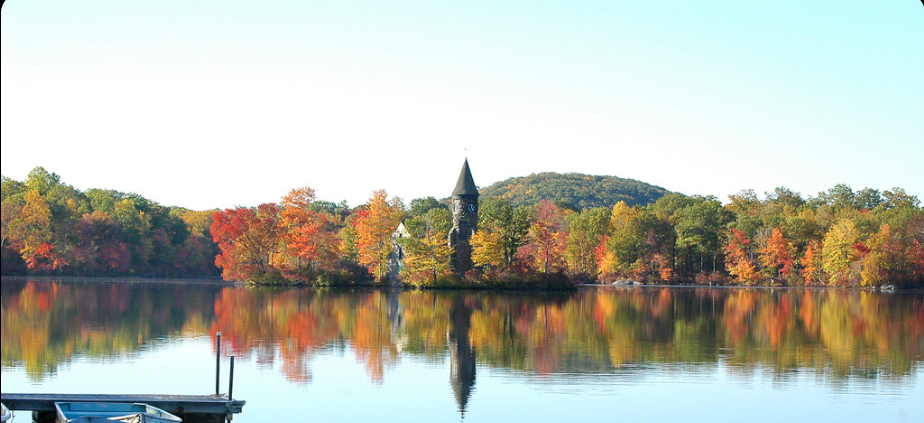
In the 1880s tobacco magnate Francis S. Kinney assembled a roughly 5,000-acre mountain estate he called “Kinney-lawn,” with St. Hubert's Chapel on an island in the lake.
A borough is born (1922)
By 1921 residents of this neglected corner of Pequannock Township — among them the estate owner Milton Untermyer and the Kinney family — were pressing to break away. On February 20, 1922, Kinnelon incorporated as a borough. Its name was drawn from the Kinney estate, carried forward by Kinney's sons Warren and Morris as a tribute to their mother, while the family's own land took the name Smoke Rise; Warren Kinney served as the first mayor. A native-stone school rose on Kiel Avenue in 1923, and by local accounts the wooded, hard-to-reach borough became a refuge for clandestine stills and speakeasies through the Prohibition years.
Water, iron, and open space
Much of Kinnelon's land remains undeveloped by design. In 1900, to secure clean water, the City of Newark bought the roughly 35,000-acre Pequannock Watershed spanning six municipalities, Kinnelon among them; together with the 625-acre Splitrock Reservoir on the Kinnelon–Rockaway line, Silas Condict County Park (dedicated 1964), and Pyramid Mountain, it preserves thousands of acres. The highlands were once worked for ore as well — the Stony Brook (or Pike's Peak) iron mine ran along the west side of Stickle Pond, the old name for Lake Kinnelon, worked anew in 1870 and abandoned by 1880. Kitty Ann Mountain is the borough's highest point.
A borough of communities
Kinnelon is really a constellation of distinct communities — Smoke Rise, Fayson Lakes, Lake Reality, and the Miller Road parish among them — each with its own founding story, gathered under one borough.
The town's first doctor
For most of its early life the borough had no physician of its own at all. That changed in the middle of the twentieth century, when Dr. Helen Miller — an Oregon-born physician trained in New York — settled at L'Ecole, the 1873 Meadtown schoolhouse, and opened a practice neighbors reached by simply knocking on her door. She went on to build Kinnelon its first medical center and a pioneering cancer-detection clinic for women, and willed L'Ecole to the borough as the Kinnelon Museum. A notable resident rather than a founding family, she has her own page in this history.
“One borough, many communities — bound by mountains, water, and a name.”