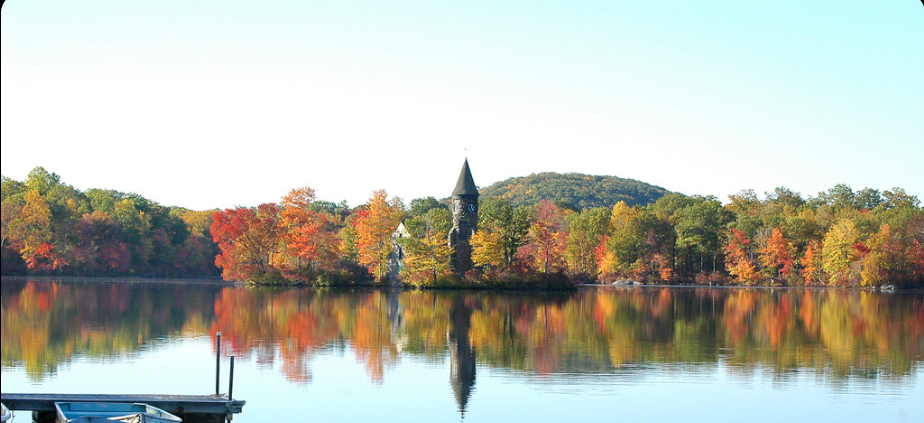
Kinnelon PlacesKakeout Reservoir (also called Butler Reservoir)

The Kakeout Reservoir — also called the Butler Reservoir — a New Deal lake on Miller Road's shoulder, and still Butler's drinking water.

Turn off Miller Road onto a small dirt road and it leads you down to a lake the federal government built during the Great Depression — one that still fills Butler's taps nearly ninety years later. Current federal and state records call it the Kakeout Reservoir; the Borough of Butler, which owns and drinks it, calls it the Butler Reservoir. (The two names have a tangled history of their own — see the note below.)

Why it was built

By the 1930s the Borough of Butler had outgrown its existing water source. Its Apshawa basin was both limited and, by the standards of the day, of poorer quality; the borough wanted a larger, cleaner supply. The Depression provided the means: federal work-relief programs could fund and staff a major public works project that a small borough could never have built alone.

How and when

Engineering was directed by Cornelius C. Vermeule of the Butler Borough Water Works. The reservoir was built by the Works Progress Administration by damming Stone House Brook — a tributary of the Pequannock — and flooding an old roadway that had once connected Butler and Kinnelon. Period newspaper accounts describe a workforce of roughly 350 men and a total cost in the range of a quarter-million dollars; early projections put its capacity around 600 million gallons. A Kinnelon borough history dates the WPA's completion to 1937, on land in Kinnelon east of Kakeout Mountain. During the Second World War, guards were even posted at the reservoir to protect the town's water supply.

Still working

The Kakeout Reservoir is still the source of Butler's drinking water. It holds roughly 950 million gallons across about 150 acres, and the Butler water system it feeds serves the borough along with the High Crest Lake section of West Milford and parts of Kinnelon — on the order of 8,000 to 9,600 people. The reservoir reaches right up to Miller Road: a small dirt road off Miller Road runs down to its bank, and the Butler–Montville Trail, maintained by New York–New Jersey Trail Conference volunteers, follows its shoreline near Fayson Lake Road. Fishing is allowed by permit only. For a body of water this size, most people never realize it's tucked just off the road they drive every day.

Period sources give different capacity figures — early projections about 600 million gallons; the current system about 950 million — and both are cited as such.

A note on the name

Is it the Kakeout Reservoir or the Butler Reservoir? Both — and the split is real. For much of the twentieth century, USGS topographic maps labeled the body “Butler Reservoir,” after the borough that built and still owns it. But current federal and state usage has settled on “Kakeout”: the U.S. Geological Survey's water data tracks the “Kakeout Reservoir Diversion near Butler”; the New Jersey DEP's Statewide Water Supply Plan lists the “Kakeout Reservoir — Borough of Butler Reservoir System”; the U.S. Army Corps of Engineers' dam inventory records the “Kakeout Dam”; and mapping services from Google to Natural Atlas mark the water as the Kakeout Reservoir. In 2020 the Borough of Kinnelon petitioned the U.S. Board on Geographic Names to make “Kakeout Reservoir” the body's official name.

The word is older than either borough. “Kakeout” derives from the Dutch kijkuit, “lookout” — a high vantage over the valley. An earlier spelling, “Kikeout,” was changed because it read too close to an ethnic slur; the modern spelling keeps the Dutch sense without the resemblance. This page uses Kakeout as the canonical name, with Butler carried alongside it, because that is where the current record points — while noting plainly that the borough, and many residents, still call it the Butler Reservoir.

What do you call it — Kakeout or Butler?Tell us

A New Deal lake on a Kinnelon road — still pouring out of Butler's taps.

Help us fill this in

This history grows with you

A few threads we'd love to document but haven't pinned down — corrections and additions welcome:

  • Photographs of the WPA construction in the 1930s
  • Names of local men who worked on the reservoir
  • The exact dam-completion and first-fill dates
  • What you call it — Kakeout or Butler (local usage, not official)

Your turn

Be the first to add to this history

A story, a correction, or a name we've missed — every piece helps. It takes a minute.

Sources

Compiled from publicly available sources; where accounts differ, the most widely documented version is used. Community corrections welcome.

Explore more of the Highlands