Not Kinnelon's first Catholic chapel
Our Lady wasn't Kinnelon's first Catholic chapel — nor the first a husband built for his wife. Forty years earlier, on an island in Lake Kinnelon, Francis Kinney raised St. Hubert's Chapel for his wife Mary.
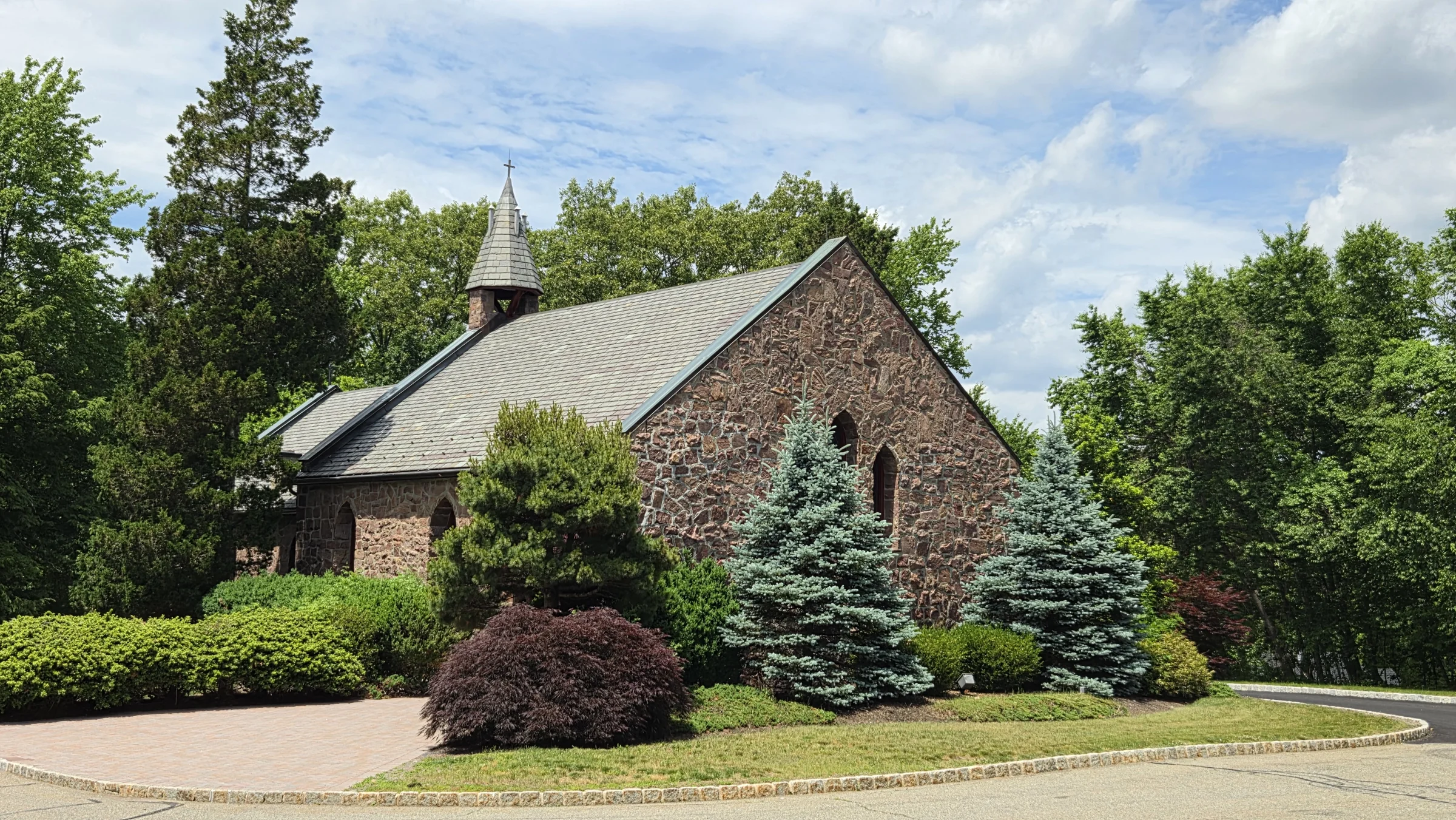
How Henry Wise Miller's tribute chapel on Miller Road grew into a parish, a school, and a church.
The little stone chapel at 2 Miller Road began as one man's tribute to his late wife — and grew, across the decades, into a full parish with a school, a convent, a cemetery, and a church, in a town that within living memory had almost no Catholic life of its own.
Our Lady wasn't Kinnelon's first Catholic chapel — nor the first a husband built for his wife. Forty years earlier, on an island in Lake Kinnelon, Francis Kinney raised St. Hubert's Chapel for his wife Mary.
1952
Henry Wise Miller had bought land in the Kinnelon hills in 1925; in 1952, he and his second wife, Audrey Frazier, bequeathed some eighty acres of it to the Diocese of Paterson for a future parish — a transfer arranged, the parish historian recounts, between Miller's attorney and the diocese's. A few stone cottages already stood on the property, and Henry was then building a chapel in honor of his first wife, the writer Alice Duer Miller, who had died in 1942.
1954
The chapel began, in a way, in another country. Henry Wise Miller had long been moved by a small medieval chapel at the edge of the Cotswolds, in the Gloucestershire parish of Harescombe — a plain stone sanctuary the parish history remembers as thirteenth-century. He never forgot it. Years later, on land he had bought in the Kinnelon hills in 1925, he set out to build it again.
At the heart of it was his first wife, Alice Duer Miller — one of the most celebrated writers of her generation, a poet, novelist, and screenwriter whose verse novel The White Cliffs moved American sympathy toward Britain on the eve of another war. The two had married at Grace Church in New York and shared a long life and a son. After Alice died in 1942, Henry wrote a memoir of their years together, All Our Lives, published in 1945; the chapel would be its companion — a tribute in stone rather than ink.
There is a grace note in how it came to be. Henry had remarried, to Audrey Frazier, and as the parish remembers it, it was Audrey who urged him to raise the chapel not for herself but for Alice — to build it in memory of his first wife. He did.
He designed the little chapel himself, faithful to the English original he carried in memory: a low stone sanctuary, intimate rather than grand, built to hold a few dozen people and a great deal of quiet. Inside, a blue rose window gathers the early light and lays it across the altar; the woodwork of the small choir loft and confessional that once stood near the entrance was made, the parish recalls, by students at a Catholic boys' school in Paterson. When Henry showed the design to Bishop James A. McNulty and spoke of his devotion to Our Lady's canticle — the Magnificat, Mary's song of praise and rejoicing — the bishop gave the chapel its name. He dedicated Our Lady of the Magnificat on July 2, 1954, assisted by Msgr. Joseph M. O'Sullivan.
Henry had little time to enjoy it. He died that September, and on September 15, 1954, the first funeral Mass ever offered in the chapel he had built was his own. He was laid first near the chapel and later reinterred in the parish cemetery on the hill above it; Alice rests in Evergreen Cemetery in Morristown. The chapel he raised in her memory still stands at 2 Miller Road — the small stone seed from which an entire parish grew.
The chapel's English model is described as medieval — the parish history calls it 13th-century; Henry's 1954 obituary said 14th.
1954–1961
After Henry's death, the estate — chapel, cottages, and grounds — was kept under the custodial care of a community of priests the parish remembers as the “Salvadorian Fathers,” described locally as Polish prelates. They tended the property until 1961, when they returned to their headquarters in Gary, Indiana, clearing the way for the diocese to begin a mission. (This custodial period is told in local accounts rather than the parish's formal history.)
1961
In 1961, Bishop McNulty opened a mission in Kinnelon and appointed Rev. John R. Ryan — a curate from St. Paul's in Clifton — as its administrator. Fr. Ryan, Morris County–born but unfamiliar with Kinnelon, offered the first Mass in the mission chapel on September 8, 1961, his brother Fr. Leo Ryan attending.
1962
A year later, in 1962, Bishop McNulty announced the canonical erection of the Parish of Our Lady of the Magnificat and named Fr. Ryan its first pastor — the beginning of a thirty-year pastorate that would later make him a monsignor.
1964
As the young parish outgrew the chapel, Fr. Ryan commissioned an eight-room school with a dual-purpose room that doubled as space for Sunday overflow Masses. The building was completed in 1964 and dedicated by Bishop James J. Navagh.
The Sisters of St. Joseph of Chestnut Hill, Pennsylvania, staffed the school, with Mother Ann Vincentia as the first superior of the convent and the school's principal. Coming from city assignments, the Sisters took to Kinnelon's country setting — ice skating and sleigh riding on the parish grounds — and taught there until they were withdrawn in 1988.
1983
Made a monsignor by Pope John Paul II in 1981, Fr. Ryan launched a campaign for a proper church. Construction finished in 1983, and Bishop Frank J. Rodimer celebrated its dedication on March 26, 1983.
2010
After 46 years, declining enrollment and rising costs forced the parish school to close in June 2010 — a painful loss for the families it had served across two generations.
Today
Our Lady of the Magnificat remains an active parish at 2 Miller Road; the stone chapel Henry built still stands at its heart.
Frequently asked
The stone chapel at 2 Miller Road, built in 1954 by Henry Wise Miller as a tribute to his late first wife, the writer Alice Duer Miller. It grew over the following decades into a full parish — a school, a convent, a cemetery, and a church.
Source: olmchurch.org — Parish History; Steve Sears (My Paper Online)
“A tribute in stone to one woman grew into a parish — a chapel, a school, a convent, and a church on Miller Road.”
Help us fill this in
A few parts of this parish's story are still open. If you have any of these, we'd be glad to add them:
Your turn
A story, a correction, or a name we've missed — every piece helps. It takes a minute.
Sources
Compiled from publicly available sources; where accounts differ, the most widely documented version is used. Community corrections welcome.
Explore more of the Highlands