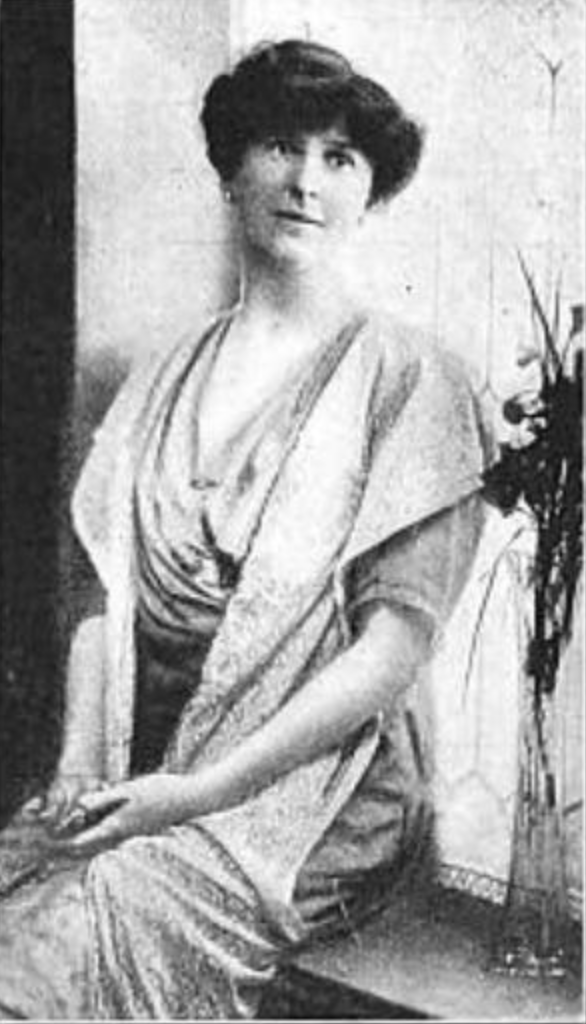
A quiet road in Kinnelon runs past a tiny stone chapel that looks like it was lifted out of the English countryside. A man built that chapel for the woman he loved — and her story is one of the best Kinnelon has, especially for any girl who has ever been told there are subjects she shouldn't study or rooms she shouldn't be in. She was a mathematician when women were rarely allowed to be one. She was told women were not “people” in the eyes of the law — and she rhymed until the law changed.
The girl who paid her own way
Alice Duer was born on July 28, 1874, into one of early America's most storied families. She was descended from two members of the First Continental Congress — Rufus King and William Duer — and from a president of Columbia College. Her forebear the banker James Gore King was so powerful on Wall Street he was nicknamed “the Almighty.” Alice grew up on the family estate in the King's Bluff section of Weehawken, New Jersey, high on the Palisades above the Hudson, with at least a dozen servants. As children, she and her sisters played near the rocky ledge below the bluff where Aaron Burr had shot Alexander Hamilton in their famous 1804 duel.
Then the family fortune collapsed in the Baring Bank failure, and the comfortable future she'd been promised vanished. Most young women of her time and class would have quietly accepted smaller lives. Alice did the opposite. She sold her own stories, poems, and essays to magazines like Harper's and Scribner's — and used the money to pay her own way through Barnard College. While still a student she and her sister Caroline published their first book, Poems, in 1896.
And she did not study the subjects thought proper for young ladies. She studied mathematics. She graduated in 1899, elected to Phi Beta Kappa, with a prize-winning thesis — and went on to do graduate work in mathematics at Columbia. For years she taught school and tutored students while her writing slowly grew into the thing that supported her whole family.
Her weapon was wit
When the fight for women's right to vote reached its peak, Alice found the perfect use for everything she had: a mathematician's precision and a writer's wit. From 1914 to 1917 she wrote a column in the New-York Tribune called “Are Women People?” The title came from a mock exchange between a father and son:
“Father, what is a Legislature?” — “A representative body elected by the people of the state.”
“Are women people?” — “No, my son; criminals, lunatics, and women are not people.”
Each column was a short, funny, devastatingly sharp poem that took the arguments against letting women vote and turned them inside out until they collapsed from their own silliness. The columns became a book, Are Women People? A Book of Rhymes for Suffrage Times, published June 12, 1915, and a sequel, Women Are People! (1917). The phrase became a slogan of the movement — Carrie Chapman Catt, who led the national suffrage association, kept a copy in her own library. In 1917 New York gave women the vote; three years later the whole country followed.
Why We Oppose Pockets for Women
1. Because pockets are not a natural right.
2. Because the great majority of women do not want pockets. If they did, they would have them.
3. Because whenever women have had pockets they have not used them.
4. Because women are required to carry enough things as it is, without the additional burden of pockets.
5. Because it would make dissension between husband and wife as to whose pockets were to be filled.
6. Because it would destroy man's chivalry toward woman, if he did not have to carry all her things in his pockets.
7. Because men are men, and women are women. We must not fly in the face of nature.
8. Because pockets have been used by men to carry tobacco, pipes, whiskey flasks, chewing gum, and compromising letters. We see no reason to suppose that women would use them more wisely.
She could make the same point in five lines:
Feminism
“Mother, what is a Feminist?”
“A Feminist, my daughter,
Is any woman now who cares
To think about her own affairs
As men don't think she oughter.”
Both poems are from Are Women People? (1915) — in the public domain. Every “reason” in the first was one used, almost word for word, against women voting. That was the joke — and the point.
What she wrote
Suffrage was only one room in a very large house. Across four decades Alice Duer Miller published some thirty books — sparkling romances and comedies like Come Out of the Kitchen (1916), The Beauty and the Bolshevist (1920), and Gowns by Roberta (1933). More than a dozen of her stories reached the screen, from Come Out of the Kitchen (1919) and Are Parents People? (1925) to Roberta (1935) and Irene (1940), and she was frequently called to Hollywood to write for the studios. In New York she earned a chair at the Algonquin Round Table, the legendary lunch table of the city's wittiest writers.
Her most famous work came at the very end. The White Cliffs (1940) is a verse-novel written as Britain stood alone in the early days of the Second World War. Several publishers turned it down — “a war is on,” “no sale for poetry” — so it first appeared in a small printing. Then the actress Lynn Fontanne read it aloud on the radio, and it became a runaway bestseller: about 700,000 copies and 33 editions by the end of the war, and a 1944 MGM film she did not live to see. (Because that work is still under copyright, we celebrate it here but do not reprint it.)
The timeline
1874
Born July 28; raised on the family estate in the King's Bluff section of Weehawken, New Jersey, above the Hudson.
c. 1890
The family fortune is lost in the Baring Bank failure.
1890s
Pays her own way through Barnard College by selling stories to Harper's and Scribner's.
1896
While still a student, she and her sister Caroline publish their first book, Poems.
1899
Graduates Barnard, Phi Beta Kappa, with a prize-winning thesis in mathematics; does graduate work at Columbia; on October 5 marries Henry Wise Miller, who had proposed three days after they met.
1899–1903
Lives abroad in Costa Rica; back in New York she teaches and writes, and her writing becomes the family's mainstay.
1914–1917
Writes the wildly popular column “Are Women People?” in the New-York Tribune.
June 12, 1915
Are Women People? is published by George H. Doran; the title becomes a slogan of the movement.
1917
Women Are People! appears. New York State grants women the vote.
August 1920
The 19th Amendment is ratified — American women win the vote nationwide.
1920s–1930s
A bestselling novelist and Hollywood screenwriter; more than a dozen of her stories become films.
September 16, 1940
The White Cliffs, rejected by several publishers, becomes a runaway bestseller (about 700,000 copies) after Lynn Fontanne reads it on the radio.
August 22, 1942
Alice Duer Miller dies in New York, age 68.
1944
MGM's film The White Cliffs of Dover reaches audiences she never lived to see.
July 2, 1954
In Kinnelon, her husband Henry builds the stone chapel Our Lady of the Magnificat in her memory; Bishop James A. McNulty dedicates it.
September 15, 1954
Henry dies at his Miller Road home; the first funeral Mass in the chapel he built is his own.
The chapel he built on Miller Road
Alice's husband, Henry Wise Miller, adored her — he proposed three days after they met. He was a man of his age: a Spanish-American War veteran, a Red Cross worker in France during the First World War (later decorated by Finland for relief work in the Second), and a retired stockbroker, author, and lecturer.
In 1925 Henry bought a tract off a quiet Kinnelon road — land that traced back to a parcel once owned by the Founding-era financier Robert Morris. A devout Anglican, Henry had long been moved by a small 13th-century chapel at the edge of the Cotswolds, in the parish of Harescombe, Gloucestershire, England. Years later, on his Kinnelon land, he built a stone chapel resembling it. When he showed the plans to Bishop James A. McNulty and spoke of his devotion to Our Lady and her canticle, the Magnificat, the bishop suggested its name: Our Lady of the Magnificat.
After Alice died in 1942, Henry remarried; and in one of the most tender footnotes in Kinnelon's history, it was his second wife, Audrey, who urged him: “Build the chapel in memory of your first wife.” He gave the chapel and some eighty acres to the Diocese of Paterson. Bishop McNulty dedicated it on July 2, 1954. Henry died that September, at his home on Miller Road — and the first funeral Mass held inside the chapel he built was his own. He had already written a memoir of their life together, All Our Lives (1945). One quiet echo remains: mathematics ran in the family — their son, Denning Duer Miller, a Kinnelon councilman and school-board member, grew up to write a mathematics textbook of his own. Whether the road itself took its name from this family or from an earlier Kinnelon family of the same name is not settled — but the chapel he built on it still keeps her memory.
No specific street address survives for the Duer estate in Weehawken — the King's Bluff land was divided among grand houses over generations — nor for the Millers' cottage on the Kinnelon property. The chapel today stands at 2 Miller Road.
Why she still matters
Alice Duer Miller was told girls didn't study mathematics. She studied it anyway — and paid for it herself. She was told women weren't “people” under the law. She picked up a pen and rhymed until that changed. She used a sharp mind and a sharper sense of humor to help win women the vote, and she made her living by her own words for forty years, in a time when few women were allowed to. One girl, who became one woman, helped change the world for millions — and we all come from women. And a quiet stone chapel in Kinnelon still keeps her memory.
Two Millers, one Kinnelon
One footnote, because Kinnelon has two well-known Millers. This is Alice Duer Miller, the poet. She should not be confused with Dr. Helen Miller, the Oregon-born physician who, decades later, became Kinnelon's first doctor and built the borough its medical center — no relation, a different Miller and a different story.
Frequently asked
Who was Alice Duer Miller?
A celebrated writer — poet, novelist, and screenwriter — whose 1915 suffrage satire Are Women People? and 1940 verse novel The White Cliffs made her nationally known. The chapel Our Lady of the Magnificat on Miller Road was built in her honor by her husband, Henry Wise Miller, in 1954.
Source: Wikipedia — Alice Duer Miller; Academy of American Poets
“Her verses moved a nation twice — once toward the vote, once toward war.”
Help us fill this in
This history grows with you
Have a memory of the chapel on Miller Road, or of the Miller family? Local recollections and photos help keep this story alive:
Local memories or photographs of the chapel and the Miller family
Your turn
Be the first to add to this history
A story, a correction, or a name we've missed — every piece helps. It takes a minute.
Read her, free
Twelve of Alice Duer Miller's books are out of copyright and digitised by Project Gutenberg, from the suffrage rhymes that made her name to the comedies Hollywood kept filming. All twelve are free to read or download. The White Cliffs is not among them; it remains in copyright, which is why this site celebrates it without reprinting it.
Add to her story, share a photo or document, or suggest a correction — with a source, so we can verify it. Every fact here is checked before it's published.